
How to Apply for a Retail Drug License in India
Quick Answer
To open a retail medical store in India you apply to your State Drug Licensing Authority — not to a central body — on Form 19, which the Drugs and Cosmetics Rules, 1945 prescribe under Rule 59(2). Once the premises and personnel meet the eligibility bar and a Drug Inspector has physically verified them, the licence itself is granted on Form 20 for general retail sale and Form 21 for Schedule C and C1 biologicals. Most standard pharmacies need both, and apply for them together. From application to grant typically takes 30 to 60 days, depending on State workload and how fast you clear documentation queries.
One point is worth settling early, because a lot of published guidance still gets it wrong: a retail drug license no longer expires. Since the amendment notified as G.S.R. 1337(E) on 27 October 2017, Rule 63 makes the licence valid perpetually — but only so long as a licence retention fee is deposited before the end of every succeeding five-year period from the date of issue. Miss that date and the rule charges a late fee of two per cent of the licence fee for every month or part of a month, for up to six months; after that the licence is deemed to have been cancelled. Perpetual is not the same as unattended.
Who Actually Issues Your Licence
Indian drug regulation runs on two tiers, and applicants routinely waste time at the wrong one. Knowing which body owns your application is the first thing to get right.
- CDSCO: The Central Drugs Standard Control Organisation handles new drug approvals, clinical trials, and manufacturing or import licences for specialised categories such as vaccines. It does not issue your shop's retail licence.
- The State Drug Licensing Authority: Usually your State FDA or Directorate of Health Services, and exclusively responsible for retail and wholesale drug licences. This is the office that receives Form 19, sends the Drug Inspector, and grants Form 20 and Form 21.
Retail licensing has stayed a State-level process even as other approvals have moved toward centralised single-window systems. You register and apply entirely through your own State's portal, and the naming and interface vary — some States run platforms modelled on ODLS-style systems, others run their own. There is no single national website for this, so treat any service promising a central retail drug licence application with suspicion.
The Forms You Apply With, and the Ones You Get
The single most common confusion in this process is treating the application form and the licence as the same document. They are not. You apply on one form and are granted a different one, and the licence forms are what an inspector asks to see on the wall.
| You apply with | You are granted | What it covers |
|---|---|---|
| Form 19 | Form 20 | General retail sale of allopathic drugs, other than those in Schedules C, C1 and X |
| Form 19 | Form 21 | Retail sale of Schedule C and C1 drugs — biologicals, sera, vaccines and other cold-chain-sensitive products |
| Form 19-C | Form 20-F | Retail sale of Schedule X drugs — a separate application, not an add-on to Form 19 |
Most medical stores need to stock both routine and cold-chain medicines to be commercially viable, so the overwhelming majority apply for Form 20 and Form 21 together as a combined application. Schedule X is the exception that trips people up: it needs its own Form 19-C, and a pharmacy that starts stocking restricted substances on the strength of a Form 20 alone is selling without the licence that category requires. For how retail compares with wholesale and composite licensing, see our guide to the Types of Drug Licenses in India.
Eligibility: What Has to Be in Place Before You Apply
This is the part applicants most often invert. You cannot apply first and assemble the infrastructure while the file is pending — the Drug Inspector verifies what physically exists on the day of the visit, against what you declared on the form. Sign the lease, fit the shop and hire the pharmacist first.
Premises
- Retail only: A minimum of 10 square metres, prescribed by the third proviso to Rule 64(2) of the Drugs and Cosmetics Rules, 1945.
- Retail and wholesale together: A minimum of 15 square metres where both are conducted from the same premises — not 10 plus 10, but a single larger floor area.
- Construction: The Rules set no clear-height figure. Several State authorities apply the National Building Code of India, 2005 as their working standard, commonly reading it as a solid, ground-floor structure of about 2.75 metres — confirm what your State actually applies rather than assuming the figure.
- Separation: The drug-selling area must be physically separated from any non-drug counter operating in the same shop — a general-store corner sharing the same space is a routine inspection finding.
Storage and Equipment
- Racking: Adequate racks and shelving so stock can be stored in an organised, retrievable way rather than in cartons on the floor.
- Cold chain: A working refrigerator for vaccines, insulin and other Schedule C products. This one has a paperwork consequence most applicants miss: the refrigerator's original purchase invoice is usually required as part of the application, so buy it in the business's name and keep the tax invoice.
- Equipment generally: Rule 64(1) also ties the licence to the minimum equipment set out in Schedule N, which is worth reading before you fit out rather than after an inspector has listed what is missing.
Personnel
A retail pharmacy cannot lawfully operate without a Registered Pharmacist. Rule 65(2) requires that any drug supplied against a Registered Medical Practitioner's prescription be supplied by, or under the personal supervision of, a registered pharmacist — which in practice means present during operating hours, not merely on the payroll. The pharmacist must hold a valid B.Pharm or D.Pharm and be registered with the State Pharmacy Council. Where the proprietor is not themselves a pharmacist, a declaration confirming the pharmacist's full-time engagement is normally required with the application.
The pharmacist's registration and the shop's licence are two different credentials that people habitually merge into one. If that distinction is not yet clear, our guide to Pharmacist Registration vs Drug License sets out which one belongs to the person and which to the premises.
The "competent person" route is a wholesale route, not a retail one
Rule 64(2) allows a licence to be held in the charge of a competent person — a registered pharmacist, or a matriculate with four years' experience in dealing with the sale of drugs, or a graduate with one year's experience in dealing with drugs. That flexibility attaches to wholesale licensing in Forms 20-B and 21-B. It does not relieve a retail pharmacy of Rule 65(2), so a retail applicant planning to run the counter on an experienced non-pharmacist is planning a violation. The Drugs Technical Advisory Board has also proposed tightening this definition more than once, so if you are relying on the matriculate-experience path for a wholesale application, confirm its current status with your State authority rather than with a blog.
The Documents That Actually Hold Applications Up
Delays in this process are overwhelmingly documentary rather than substantive. Applications rarely fail because the shop is unsuitable; they stall because a name is spelled differently on two documents, or a rent agreement has lapsed. Have clear, self-attested scans of the following ready before you open the portal.
- Identity and constitution: Aadhaar, PAN and Voter ID or Driving Licence of the proprietor, partners or directors; passport-size photographs of the applicant and the pharmacist; the partnership deed, or Certificate of Incorporation with MOA, AOA and a board resolution for a company; and a notarised affidavit declaring non-conviction under the Drugs and Cosmetics Act, 1940.
- Premises: If owned, the sale deed or other ownership proof with a recent utility bill or tax receipt. If rented, a valid and current rent or lease agreement, rent receipt, and the landlord's ownership proof, plus a no-objection certificate from the owner permitting a drug retail business specifically. Add a signed site plan showing the exact carpet area and storage layout, and the original tax invoice for the refrigerator.
- Pharmacist: The final degree or diploma certificate, the current State Pharmacy Council registration certificate, an appointment letter and biodata, and a notarised affidavit confirming the pharmacist's acceptance of the role and full-time engagement.
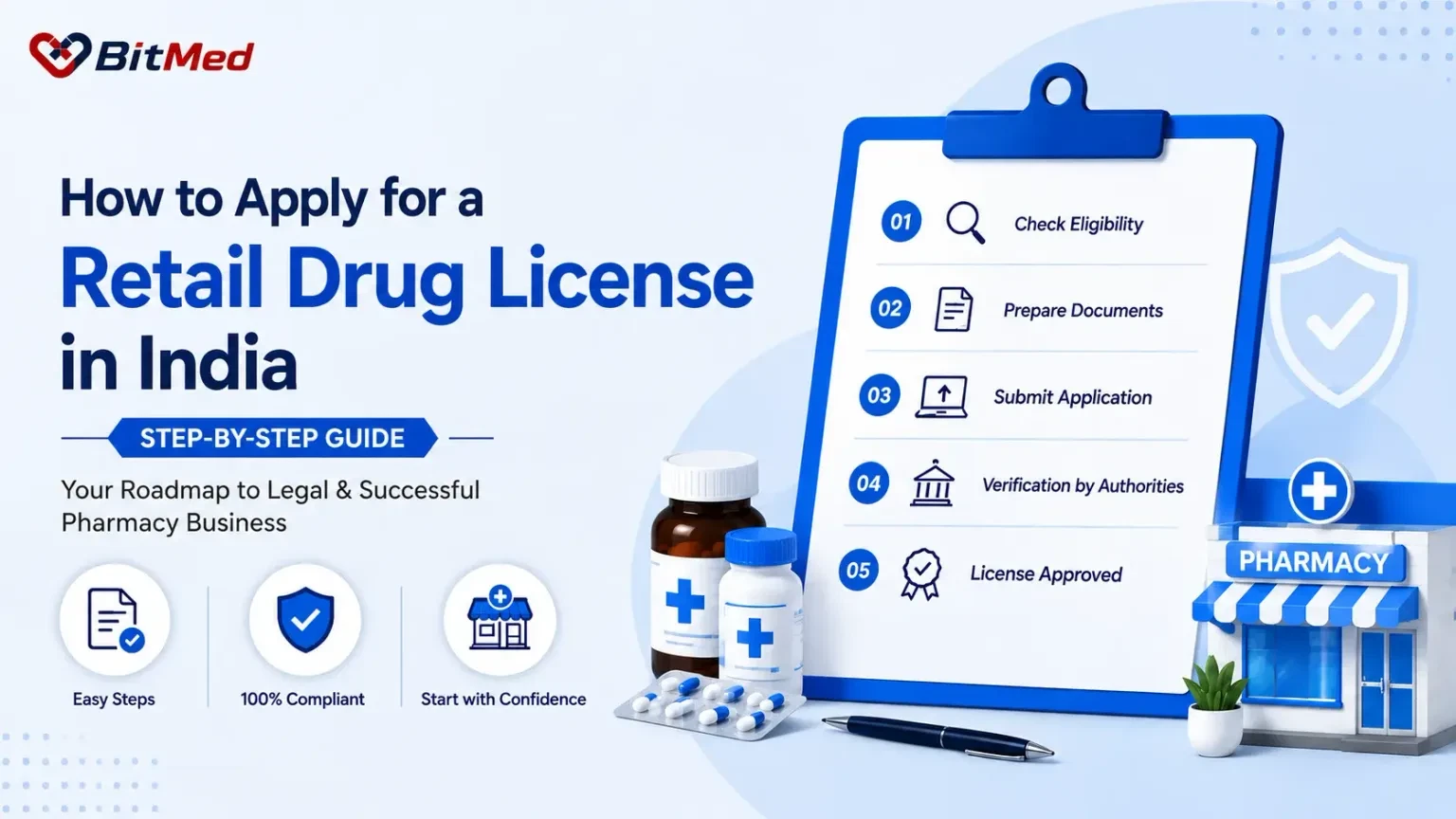
The Application Process, Step by Step
- 1
Get the premises genuinely ready
Sign the lease, install the racks, buy the refrigerator and finalise the pharmacist's employment. Do not begin the online application before this is real — the inspection tests the shop, not the intention.
- 2
Register on your State's portal
This is a State-specific system, not a central national portal. Create the account in the name the business will actually trade under, because mismatches here propagate into every later document.
- 3
Complete Form 19
Enter the business details, the exact premises measurements and the pharmacist's registration number carefully. Measurement and name mismatches between the form, the site plan and the lease are the most common cause of queries.
- 4
Upload documents and pay the fee
Upload the document set assembled above, then pay the prescribed government fee and save both the e-receipt and the application acknowledgment. You will need the acknowledgment number to track the file and to answer any query raised against it.
- 5
Pass the Drug Inspector's verification
The inspector checks actual carpet area against your site plan, the refrigerator's presence and functioning, the pharmacist's physical presence with original certificates, and the separation of the drug area from any other business in the shop.
- 6
Answer queries inside the window
Minor discrepancies usually produce an online query with a response deadline rather than an outright rejection. Files are far more often lost to an unanswered query than to a refusal.
- 7
Download the licence
On approval, Form 20 and Form 21 become available from your portal dashboard. In most States no physical visit is needed to collect them.
The full cycle typically runs 30 to 60 days. That figure is practice rather than a statutory guarantee, and it moves with State workload and with how quickly you answer what the department asks for.
What Happens After You Are Licensed
The grant is the starting line. Everything that gets a pharmacy into trouble later is an ongoing obligation rather than a one-off filing.
- Retention, not renewal: The licence does not expire, but the retention fee falls due every five years from the date of issue, and the late-fee ladder under Rule 63 ends in deemed cancellation. Our guide to Drug License Renewal covers the deadlines and the documents.
- Prescription recordkeeping: Schedule H and H1 drugs may only be sold against a valid prescription, with H1 requiring its own bound register of prescriber, patient and quantity details. The Schedule H Register Format guide sets out the columns and retention period.
- Purchase records: Organised invoices proving every batch on the shelf came from a licensed source. This is the record inspectors ask for when stock and books do not reconcile.
- Expired stock separation: Expired and damaged drugs need their own register and their own storage space, kept physically apart from saleable inventory.
- Inspection readiness: The obligations above are exactly what a routine inspection tests. What happens if a pharmacy fails a drug inspection is worth reading before one is scheduled rather than after.
For the complete regulatory picture around the licence — GST registration, the records that sit alongside it, and how the pieces interact — see our Pharmacy Drug Licensing and Compliance guide.
Rule references here are to the Drugs and Cosmetics Rules, 1945, whose provisions have been amended repeatedly, and application procedure, fees and accepted document formats are set by each State separately. This is general information, not legal advice — confirm the current requirements with your State Drug Licensing Authority or a compliance professional before filing.
Frequently Asked Questions
What form do I use to apply for a retail drug license?
Form 19. Approval results in Form 20 for general retail sale and Form 21 for Schedule C and C1 drugs, and those are your actual licence certificates. Sale of Schedule X drugs requires a separate application on Form 19-C, which results in Form 20-F.
How long does it take to get a retail drug license in India?
Typically 30 to 60 days from application to grant, assuming the documentation is complete and the physical inspection raises nothing unresolved. It is a practical range rather than a statutory deadline, and it varies by State.
Do I need a Registered Pharmacist for a retail drug license?
Yes, and it is not negotiable for retail. Rule 65(2) requires supply against a prescription to be made by or under the personal supervision of a registered pharmacist. Wholesale licensing is the more flexible route, through the competent person under Rule 64(2).
What is a competent person under Rule 64?
Someone who can hold charge of a wholesale licence in place of a registered pharmacist — a matriculate with four years' experience in dealing with the sale of drugs, or a graduate with one year's experience in dealing with drugs. The definition has repeatedly been proposed for tightening, so confirm its current status with your State authority before relying on it.
Does a retail drug license expire?
No. Since the 2017 amendment to Rule 63 it remains valid perpetually, provided the licence retention fee is deposited before the end of every five-year period from the date of issue. Non-payment attracts a late fee and ultimately deemed cancellation, so perpetual validity is conditional, not automatic.
What is the minimum shop size for a retail drug license?
Ten square metres for retail only, and fifteen square metres where retail and wholesale are conducted from the same premises, under the provisos to Rule 64(2). The Rules set no clear-height figure; several States apply the National Building Code of India, 2005 as a working standard.
Can I apply for a drug license without owning the shop?
Yes. A valid rent or lease agreement, together with the landlord's ownership proof and a no-objection certificate permitting a drug business at the address, is an accepted alternative to ownership documents.
Conclusion
A retail drug license application comes down to three things done in the right order: make the premises and the pharmacist genuinely ready before you apply, assemble a document set that agrees with itself, and clear the inspection without leaving gaps open. The process has become markedly more digital and more predictable in recent years, but the underlying eligibility bar — real floor area, working cold storage, a registered pharmacist actually present — has not softened, and it is not treated as a formality by the people who verify it.
The other half of the job starts the day the licence is granted. Retention deadlines, prescription registers and purchase records all have to run together, and they are far easier to keep straight from day one than to reconstruct in front of an inspector.
Before you commit the capital, it is worth knowing what the business actually earns: our profitability guide covers setup costs by market tier, the margin structure behind a medical store, and the twelve-to-eighteen-month ramp to a stable monthly profit.
Start compliant, stay compliant
BitMed's Pharmacy Management Software keeps GST billing, batch and expiry tracking, and Schedule H recordkeeping in one place, so a newly licensed pharmacy builds the right habits from its first sale.
Explore BitMed