
Pharmacy Compliance Checklist: Documents Every Store Must Keep Ready
Quick Answer
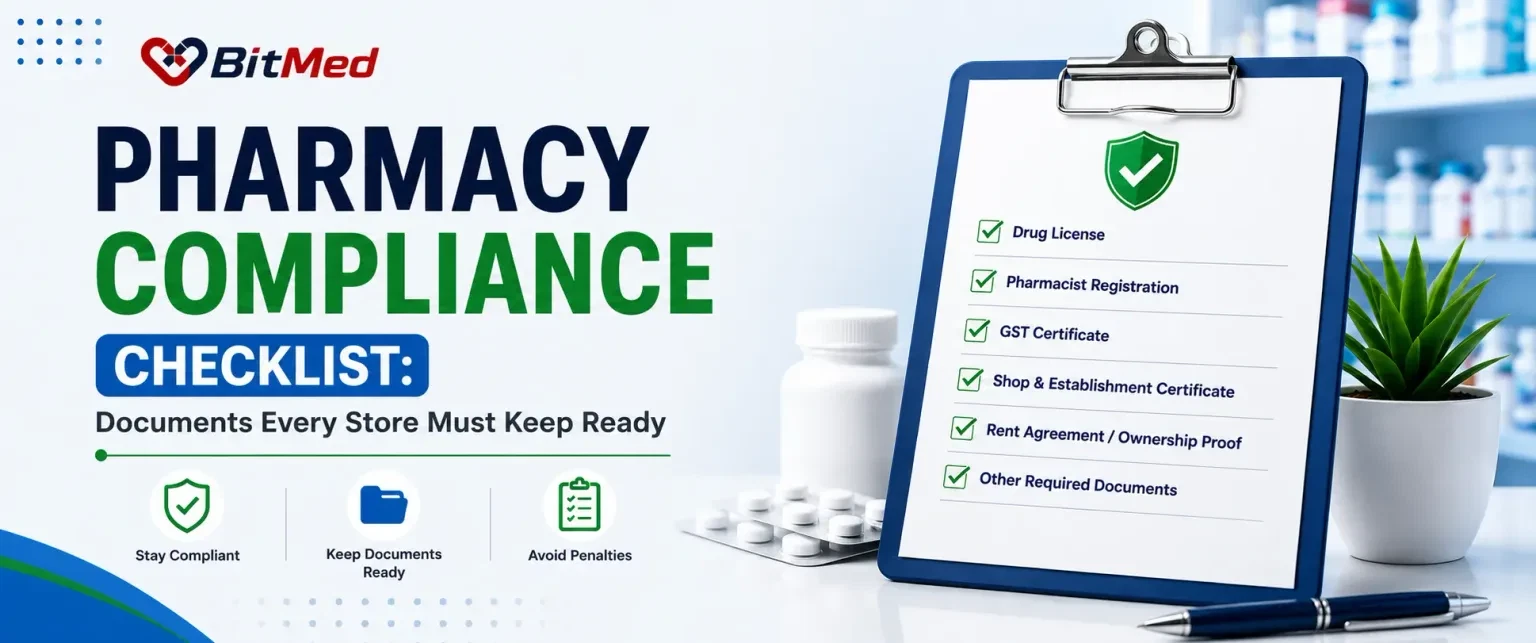
This pharmacy compliance checklist covers six things an Indian retail pharmacy must be able to produce on demand: its sale licence and the retention-fee receipts that keep it alive, the registered pharmacist's registration certificate, the Schedule H1 register, purchase records under Rule 65(4), GST-compliant invoices and filed returns, and premises and equipment matching Schedule N. Nothing on that list is optional, and none of it can be assembled after the inspector arrives — the burden is on the pharmacy to produce records instantly, not to explain why they are incomplete.
The part most checklists get wrong is retention. The periods are not uniform, and a single blanket policy will under-retain something. The default sits in Rule 65(7) of the Drugs and Cosmetics Rules, 1945 — not less than two years from the date of the last entry — while the Schedule H1 register runs three years under clause (h) of Rule 65(3)(1), and GST records run 72 months from the due date of the annual return under Section 36 of the CGST Act.
Why This Matters
Non-compliance is not a paperwork inconvenience — it is a licensing risk. A missing H1 register, an unverifiable purchase bill, or a lapsed licence can result in warnings, fines, prosecution, or suspension of the drug licence, depending on the severity and the frequency of the lapse. Inspections happen with little notice, and what an inspector records in the inspection report is what the department acts on afterwards.
The good news is that this is a finite list. Once you know exactly which document answers to which rule, keeping the set audit-ready is routine rather than scramble — and most of it is a by-product of billing and purchasing correctly in the first place.
1. Licensing Documents
These establish your legal right to operate, and several of them have to be displayed on the premises rather than merely filed.
- The sale licence itself: Form 20 covers general retail sale, and Form 21 covers Schedule C and C1 items — biologicals, vaccines, insulin. Most standard pharmacies stock both categories and therefore hold both licences, applied for together on Form 19.
- Licence retention fee receipts: Keep every receipt. Since the 2017 amendment a sale licence no longer expires, but it survives only while the retention fee is deposited before the end of each successive five-year period from the date of issue — so the receipts are the proof that a perpetual licence is still live.
- The registered pharmacist's registration certificate: Rule 64(1) requires the premises to be in the charge of a person competent to supervise and control the sale, distribution and preservation of drugs, and Schedule N requires that a pharmacy be conducted under the continuous personal supervision of a Registered Pharmacist whose name is displayed conspicuously on the premises.
- GST registration certificate: The GSTIN certificate, which also has to be displayed at the principal place of business.
- Shop and establishment registration: Where your State's shops and establishments law applies to the premises.
- Premises documents: Rent agreement or ownership proof, plus the approved site plan. Licence validity is tied to the specific registered premises, so a move is a licence event, not just an address change.
- A separate Form 20-F for restricted stock: Schedule X cannot be added under an existing Form 20 or 21. It needs its own application on Form 19-C under Rule 59(2), granted under Rule 61(3) as Form 20-F for retail — Form 20-G is the wholesale equivalent.
Perpetual is not the same as unattended
The change that made sale licences perpetual is the Drugs and Cosmetics (Tenth Amendment) Rules, 2017, notified as G.S.R. 1337(E) on 27 October 2017 — not a recent amendment, despite how often it is described as one. Rule 63(3) allows the retention fee to be paid late for up to six months, with a late fee of two per cent of the licence fee per month or part month. After that window the licence is deemed to have been cancelled — automatic, with nothing left to restore by paying afterwards.
2. The Schedule H1 Register
This is the single most-checked record in a routine pharmacy inspection, and the one most often found incomplete. Clause (h) of Rule 65(3)(1) requires that the supply of a Schedule H1 drug be recorded in a separate register at the time of supply — not reconstructed at the end of the day, and not merged into the general prescription register.
The clause itself names only four particulars: the name and address of the prescriber, the name of the patient, the name of the drug, and the quantity supplied. Most printed formats and most software capture more, because the extra fields are what make an entry verifiable against the bill it came from:
- Serial number of the entry.
- Date of supply.
- Prescriber's name, address, and registration number.
- Patient's name and address.
- Drug name, batch number, and expiry date.
- Quantity dispensed.
- The dispensing pharmacist's name and registration number.
- Bill number and date, linking the entry to the sale.
The register must be kept for three years and be open for inspection. Corrections and cancellations should be struck through and initialled rather than erased or deleted — an entry that vanishes without trace is worse for you than an entry that was wrong and visibly corrected.
3. Purchase and Sale Records
Rule 65(4) requires records of purchase of every drug intended for sale by retail, showing the date of purchase, the name and address of the supplier together with the number of the licence they hold, the name of the drug, the quantity, the batch number, and the manufacturer's name. Purchase bills — cash or credit memos — must be serially numbered by the licensee and kept in chronological order.
This is worth more than its compliance value. A pharmacy that can produce a clean purchase trail linking every batch on the shelf to a licensed source is in a strong position even when a quality problem later surfaces on a specific product — the trail is what shows the stock entered your premises legitimately.
On the sale side, Rule 65(2) requires supply against a prescription to be made by or under the personal supervision of a registered pharmacist, and the prescription register or the cash and credit memos kept in its place carry the particulars of each supply. Sales of Schedule C and C1 drugs additionally need the manufacturer's name, batch number, and expiry date recorded, with the signature of the person under whose supervision the sale was effected — Rule 65(4) does not require that person to be a registered pharmacist, which matters because this provision governs Schedule C sales made without a prescription.
4. GST-Compliant Invoices and Returns
Rule 46 of the CGST Rules sets the particulars a tax invoice must carry. For a pharmacy counter, the ones that get queried are the invoice number series and the rate-wise breakdown:
- Pharmacy name, address, and GSTIN.
- A consecutive serial number unique for the financial year, with no gaps — a broken series is the single most common GST query at a retail counter.
- Date of issue.
- HSN code and the applicable GST rate for each line item.
- Taxable value, and the CGST and SGST split for intra-state supply or IGST for inter-state.
- Place of supply, and the recipient's name, address and GSTIN where the sale is B2B.
Alongside the invoices, keep GSTR-1 (outward supplies, invoice-wise for B2B and aggregated by rate slab for B2C) and GSTR-3B (the summary return carrying input tax credit) filed and organised by period, ready to reconcile against your sales register if the figures are questioned. Under Section 36 of the CGST Act these records must be retained for 72 months from the due date of furnishing the annual return for that year — and if an appeal, revision, or investigation is pending, for one year after its final disposal, even if that runs past the 72 months.
5. Schedule X Records
Schedule X is the strictest category under the Drugs and Cosmetics Rules — habit-forming and psychotropic substances with a high potential for abuse. If you stock them, three additional records apply on top of everything above.
- A bound, serially page-numbered register: Rule 65(21) requires it to be maintained specially for the purpose, with separate pages allotted to each drug and entries written up at the time of supply.
- Duplicate prescriptions, retained two years: Under Rule 65(9) a Schedule X prescription must be presented in duplicate, and the pharmacy retains one copy for two years. Supplies to practitioners, hospitals, dispensaries and nursing homes go against a signed written order instead, preserved for the same period.
- Locked storage, separate from general stock: Schedule N separately requires a cupboard with lock and key for poisons, clearly marked "POISON" in red letters on a white background, with the keys in the personal custody of the responsible person.
Forms 3D, 3E and 3H are not retail pharmacy forms
Checklists routinely tell retail pharmacies to maintain NDPS Forms 3D, 3E and 3H alongside their Schedule X records. They should not. Those forms are prescribed under Rules 52H and 52R for registered medical practitioners and Recognised Medical Institutions — not for a retail chemist's commercial ledger. Two separate mistakes follow from confusing them: a retail pharmacy keeps a form it never owed while leaving Rule 65(21) and Rule 65(9) incomplete, and Schedule X gets treated as interchangeable with NDPS narcotics, which run on a distinct Rule 52B licence and their own records.
If you handle essential narcotic drugs as well, that is a third compliance track again, with its own licence and its own register obligations — covered separately in our guide to the narcotic drug register.
6. Premises and Equipment Under Schedule N
Inspectors do not only check paper — they check the shop floor. Rule 64(1) ties the licence to premises that are adequate and equipped with proper storage accommodation for preserving the properties of the drugs stocked, and to the minimum equipment set out in Schedule N. Schedule N is more specific than most owners expect:
- Premises: Separated from rooms in private use, well built, dry, well lit and ventilated, with a smooth washable floor and walls kept smooth, durable and washable, free of holes, cracks and crevices. The dispensing area must be at least 6 square metres for one pharmacist, plus 2 square metres per additional pharmacist, with a height of at least 2.5 metres.
- A locked poison cupboard: Marked "POISON" in red letters on a white background, with any container returned to it immediately after use.
- A dispensing bench: Topped with a washable, impervious material such as stainless steel or laminate, and a dispensing area separated from the public by a barrier.
- Reference books, current editions: The Indian Pharmacopoeia and the National Formulary of India in their current editions, plus the Drugs and Cosmetics Act, 1940, the Drugs and Cosmetics Rules, 1945, the Pharmacy Act, 1948, and the Dangerous Drugs Act, 1930. The last two are the ones most often missing from the shelf.
- Cold chain, where you stock Schedule C and C1: A working refrigerator for vaccines, insulin and other temperature-sensitive products. This requirement comes from Rule 64(1)'s storage accommodation condition rather than from Schedule N, whose apparatus list does not mention refrigeration — and State checklists commonly ask for the refrigerator's purchase invoice at application.
- Shopfront inscription, water, and overalls: Schedule N opens by requiring the front of the pharmacy to bear the inscription "Pharmacy", and separately requires an ample supply of good quality water and that the pharmacist always wear clean white overalls. All three are visible on sight and all three are routinely left off checklists.
Schedule N closes with a note that its requirements may be relaxed or added to at the discretion of the licensing authority, having regard to the nature of the drugs dispensed, and that the authority's decision is final.
7. Audit Trail
Beyond the statutory registers, keep a running log of every bill, return, void, and stock adjustment, recording which user performed each action and when, in a form that can be exported for internal review or handed to an auditor. Nothing in the Drugs and Cosmetics Rules names an "audit trail" as such — Schedule N simply requires that all records and registers be maintained in accordance with the laws in force — but it is what turns "we believe we are compliant" into evidence, particularly where a register entry has been corrected and you need to show why.
8. Staff and Supervision Records
- Registration certificates for every pharmacist on staff, current and displayed.
- A duty roster showing pharmacist supervision across all operating hours — Schedule N requires continuous personal supervision, so a roster with uncovered hours is itself a finding.
- Records of any change in the pharmacist-in-charge, reported to the licensing authority as your State requires.
Quick Reference: Retention Periods
| Record | Minimum retention | Source |
|---|---|---|
| Schedule H1 register | 3 years, open to inspection | Clause (h) of Rule 65(3)(1) |
| Prescription register, and most other registers and records | 2 years from the date of the last entry | Rule 65(7) |
| Retail cash / credit memos kept in place of the register | 2 years from the last entry | Rule 65(7) — the 3-year clock in Rule 65(5)(2) governs wholesale memos |
| Schedule X prescriptions (one copy of the duplicate) | 2 years | Rule 65(9) |
| GST invoices, returns, and books of account | 72 months from the due date of the annual return | Section 36, CGST Act, 2017 |
| Audit trail / transaction logs | Ongoing, non-deletable | Not separately prescribed; supports the records above |
Making This a Non-Event
The pharmacies that pass inspections cleanly are not the ones that assemble paperwork the night before. They are the ones where the records are a by-product of daily work: the H1 register is filled at the moment a restricted drug is billed, GST is computed correctly on every line as the bill is made, and purchase entries are logged the day stock arrives rather than during a filing catch-up weeks later.
That is the gap BitMed is built to close. Billing opens the Schedule H1 register entry automatically when a Schedule H1 drug is added to a bill, GST is calculated per line item, GSTR-1 and GSTR-3B data comes straight off your sales, and every transaction leaves a tamper-evident audit trail — so the records already exist when an inspector asks, in the form the rule requires.
Frequently Asked Questions
What documents does a drug inspector check first in a pharmacy?
Typically the sale licence and its retention-fee receipts, the pharmacist's registration certificate, and the Schedule H1 register — the last being the record most often found incomplete. Purchase bills under Rule 65(4) and the premises conditions under Rule 64(1) and Schedule N follow.
How long must a pharmacy keep the Schedule H1 register?
Three years, and it must be open for inspection, under clause (h) of Rule 65(3)(1) of the Drugs and Cosmetics Rules, 1945. This is an exception to the general rule — most other registers and records run two years from the date of the last entry under Rule 65(7).
How long must pharmacy purchase bills be kept?
Two years from the date of the last entry, under Rule 65(7). The three-year period some checklists quote comes from Rule 65(5)(2), which governs memos for supply by wholesale, not a retail counter's purchase records.
Does a retail drug licence still need to be renewed?
No. Since G.S.R. 1337(E) of 27 October 2017, a sale licence remains valid perpetually unless suspended or cancelled. What recurs is a licence retention fee, due before the end of every five-year period from the date of issue. Missing it attracts a late fee for up to six months, after which the licence is deemed cancelled.
Does a retail pharmacy need to maintain NDPS Forms 3D, 3E, or 3H?
No. Those forms are prescribed under Rules 52H and 52R for registered medical practitioners and Recognised Medical Institutions. A retail chemist's obligations come from the conditions of its licence together with the purchase, prescription, and Schedule H1 records under Rule 65 — and, for Schedule X, the Rule 65(21) register and Rule 65(9) duplicate prescriptions.
Can Schedule X drugs be sold on a normal Form 20 licence?
No. Schedule X requires a separate licence applied for on Form 19-C under Rule 59(2) and granted under Rule 61(3) as Form 20-F for retail sale, with Form 20-G the wholesale equivalent. Stocking Schedule X on a Form 20 or Form 21 alone is selling without the licence that category requires.
How long do GST records have to be kept in India?
Seventy-two months from the due date of furnishing the annual return for that financial year, under Section 36 of the CGST Act, 2017. Where an appeal, revision, or investigation is pending, the related records must be kept for one year after its final disposal even if that extends beyond the 72 months.
Can a pharmacy keep these registers digitally?
Software can generate and hold these records, and doing so is what makes an entry-at-the-time-of-supply requirement realistic at a busy counter. Practice on accepting purely electronic registers still varies by State, so confirm your State Drug Control Organisation's position, and keep the digital records exportable and printable on demand either way.
This article is for general informational purposes and reflects the Drugs and Cosmetics Rules, 1945 and related GST provisions as commonly applied to Indian retail pharmacies. Requirements vary by State and are subject to ongoing amendment — verify current rules with your State Drug Control Organisation before relying on this as legal or compliance advice.
Want these records to keep themselves?
See how BitMed opens the H1 register at billing, calculates GST per line item, and keeps an exportable audit trail of every transaction.
Explore BitMed