
Schedule H Register Format: A Complete Compliance Guide
Quick Answer
The Schedule H register format is fixed by Rule 65(3)(1) of the Drugs and Cosmetics Rules, 1945: every retail pharmacy in India must record Schedule H sales in a prescription register maintained specially for the purpose. The entry has to be made at the time of supply — not reconstructed at closing time — and must carry seven particulars: a serial number (also written back onto the prescription), the date of supply, the prescriber's name and address, the patient's name and address, the drug name and quantity, the manufacturer, batch number and expiry date, and the signature of the registered pharmacist who supplied or supervised the supply.
The register must be preserved for not less than two years from the date of the last entry. One record carries a longer clock: the separate Schedule H1 register, which clause (h) requires to be kept for three years.
What Schedule H Drugs Are, and Why the Register Matters
Schedule H is the core prescription-only category under the Drugs and Cosmetics Rules, 1945 — hundreds of everyday therapeutic drugs, including standard blood pressure medication, diabetes treatments, common painkillers and conventional antipsychotics. None of them may be sold over the counter; each requires a valid prescription from a Registered Medical Practitioner (RMP).
The register exists to make every one of those sales traceable — from the manufacturer's batch, through the counter, to the specific patient who received it. That is why a Drug Inspector typically asks for it early in a visit: it is the clearest available evidence of whether prescription-only rules are being followed in practice rather than merely acknowledged on paper.
The Legal Basis: Rule 65(3)(1)
Rule 65 sets out the conditions attached to retail sale licences — Forms 20, 21 and their variants. Sub-rule (3)(1) is the operative one here: the supply of any drug other than those specified in Schedule X, on the prescription of a Registered Medical Practitioner, shall be recorded at the time of supply in a prescription register maintained specially for that purpose, and the serial number of that entry shall be written onto the prescription itself.
That last requirement does more work than it appears to. It creates a two-way link between the physical prescription the patient walks out with and the pharmacy's internal log — which is precisely what an inspector follows when verifying that a particular sale actually happened the way the register claims.
Where the two-year clock actually comes from
The retention period is not stated inside Rule 65(3)(1). It sits in Rule 65(7), which provides that except where otherwise provided, all registers and records maintained under the rules shall be preserved for not less than two years from the date of the last entry therein. The distinction matters because the real exception — the Schedule H1 register at three years under clause (h) — is narrower than most pharmacies assume, and the three-year clock in Rule 65(5)(2) belongs to wholesale memos rather than to anything on a retail counter.
The Schedule H Register Format: Required Columns, One by One
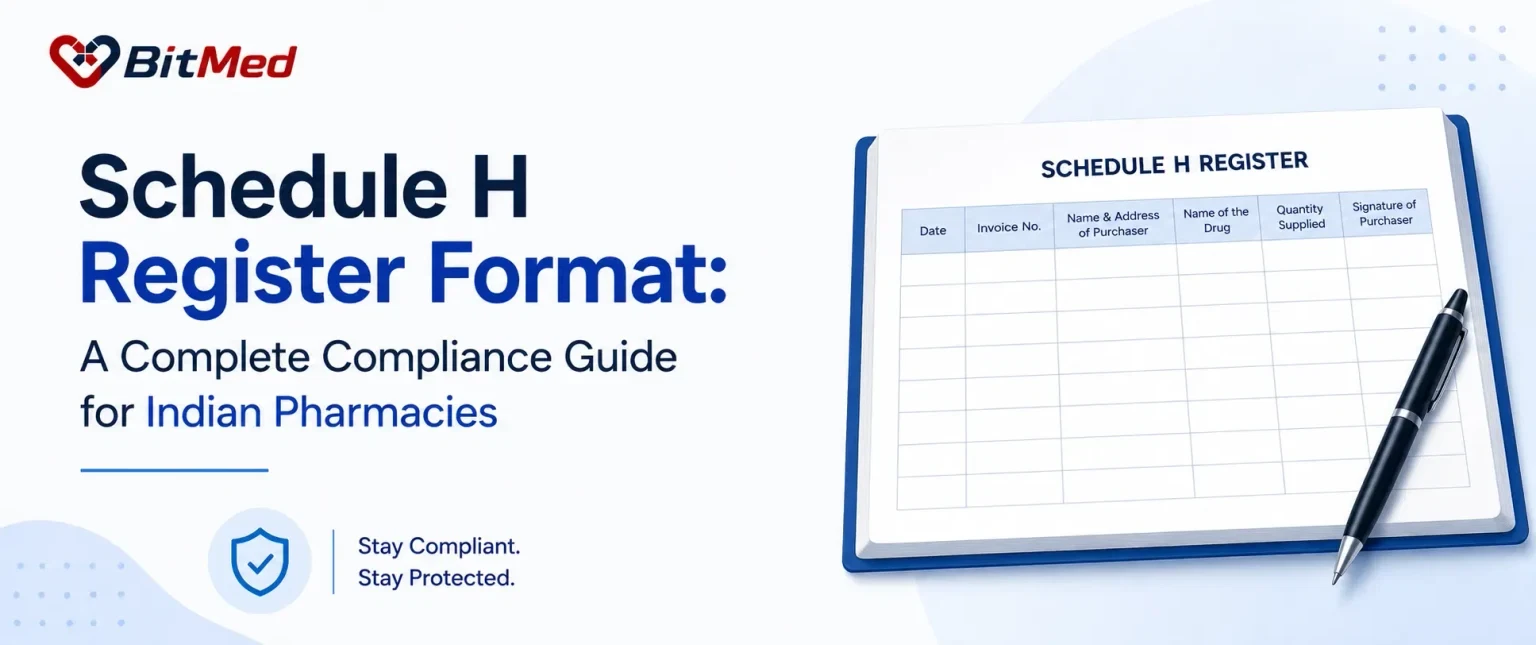
Rule 65(3)(1) lists the particulars as clauses (a) through (g). The Schedule H register format is simply those seven clauses turned into columns:
| Column | What it must capture |
|---|---|
| A. Serial number | A unique, sequential number for each entry — also written back onto the original prescription |
| B. Date of supply | The date the medicine was actually dispensed, which is not necessarily the date on the prescription |
| C. Prescriber's name and address | The full name and address of the RMP. "Dr. Sharma" on its own does not satisfy the clause |
| D. Patient's name and address | Or, where the drug is supplied for veterinary use, the name and address of the animal's owner |
| E. Drug name and quantity | The name of the drug and the quantity supplied — and, where the medicine is compounded, its ingredients |
| F. Manufacturer, batch number and expiry date | Required for drugs specified in Schedule C as well as Schedule H and Schedule H1 — not biologicals alone |
| G. Pharmacist's signature | The registered pharmacist who supplied, or supervised the supply of, the medicine |
The batch column is not optional for ordinary tablets
Clause (f) is widely misread as applying only to Schedule C biologicals. It reads "in the case of a drug specified in Schedule C or Schedule H and Schedule H1", so an ordinary Schedule H tablet needs its manufacturer, batch number and expiry date recorded like anything else. An empty batch column is one of the fastest ways to fail an inspection, because it means the pharmacy cannot identify which patients received a specific batch when a recall is issued — which is the whole reason the column exists.
The Repeat-Prescription Relief
For chronic-care patients collecting the same medicine repeatedly, the rule includes a genuine simplification. Under the proviso to Rule 65(3)(1), where a medicine is supplied on a prescription against which it has already been supplied on a previous occasion, the new entry need not repeat the full prescriber and patient profile. It is sufficient to record a new serial number, the date of supply, the quantity supplied, and a sufficient reference back to the earlier entry.
One caveat is easy to miss alongside it. Rule 65(11)(a) provides that a prescription must not be dispensed more than once unless the prescriber has stated on it that it may be, and any stated interval or frequency has to be observed. The proviso shortens the bookkeeping for a lawful repeat; it does not create a right to repeat.
The Alternative: Cash or Credit Memos
For a high-volume counter, handwriting a full register entry for every sale is a real bottleneck. Rule 65(3)(1) provides a way out: for drugs that are not compounded on the premises and are supplied from or in the original containers, the particulars in items (a) to (g) may instead be entered in a cash or credit memo book, with carbon copies preserved as the record. The proviso attaches two conditions that are easy to miss — the book must be serially numbered, and specially maintained for this purpose. An ordinary bill book doing double duty does not satisfy the clause.
It is widely assumed that this alternative carries a longer retention period. For a retail counter it does not. The three-year clock for carbon copies sits in Rule 65(5)(2), which governs the memos specified in Rule 65(5)(1) — and that sub-rule opens with the supply of a drug by wholesale. A retail memo book kept under the proviso to Rule 65(3)(1) has no retention period of its own, so Rule 65(7) applies to it: not less than two years from the date of the last entry, exactly like the register it replaces.
The choice is also not made informally at the counter. Rule 65(3)(2) requires the option to be exercised in writing to the licensing authority at the time of the licence application, and the authority may insist on a prescription register instead if it is satisfied that entries in the carbon copies are not legible. Because the 2017 amendment removed periodic renewal from the sale-licence provisions and replaced it with perpetual validity and a five-year retention fee, there is no longer a renewal cycle at which to casually revisit that election — so getting it right at grant, and staying consistent afterwards, matters more than it did before.
Schedule H vs Schedule H1: Not the Same Register
A frequent and consequential mistake is treating Schedule H1 as a stricter tier of Schedule H that can share the same book. It cannot. Schedule H1 was introduced by G.S.R. 588(E) of 30 August 2013 — in force from 1 March 2014 — to address antimicrobial resistance and the misuse of habit-forming drugs, and clause (h) of Rule 65(3)(1) requires its sales to be recorded in a separate register with its own particulars and its own retention period.
| Aspect | Schedule H register | Schedule H1 register |
|---|---|---|
| Separate register required? | This is the base register under Rule 65(3)(1) | Yes — a separate register is mandatory; combining the two is a violation |
| Particulars required | Serial number, date, prescriber name and address, patient name and address, drug and quantity, manufacturer/batch/expiry, pharmacist's signature | Prescriber's name and address, patient's name, name of the drug, quantity supplied |
| Patient address required? | Yes, under clause (d) | No — clause (h) asks only for the name of the patient |
| Retention period | Two years from the date of the last entry, under Rule 65(7) | Three years, stated in clause (h) itself |
| Label symbol under Rule 97 | Red "Rx" on the left top corner, with the Schedule H warning | Red "Rx", plus the Schedule H1 warning inside a red-bordered box |
The narrower particulars are not a licence to be casual — the shorter H1 entry still has to be made at the time of supply, in its own book, and produced on demand. For the full walkthrough of H1-specific obligations, see BitMed's guide to H1 register software.
Rx, NRx and XRx: The Labelling Distinction
Rule 97 governs which symbol goes on the label, and the three are routinely confused with one another:
- Rx: The red symbol carried by standard Schedule H and Schedule H1 drugs, conspicuously displayed on the left top corner of the label, with the applicable warning text. Schedule H1 adds its warning inside a red-bordered box.
- NRx: Used where a Schedule H drug also falls within the purview of the Narcotic Drugs and Psychotropic Substances Act, 1985. It signals that dual regulatory status — it is not a marker of Schedule H1 classification.
- XRx: The symbol for Schedule X drugs since the 2018 labelling amendment, in red on the left top corner alongside a caution in a red rectangular box. Older material sometimes calls this an "NRx" label, which predates the change and is now wrong.
The short version: NRx is about NDPS Act overlap, XRx is about Schedule X, and neither is a synonym for the other or for Schedule H1.
Where Essential Narcotic Drugs Fit — and Don't
It is worth being clear about scope. Most standard retail pharmacies do not stock or dispense Essential Narcotic Drugs such as morphine or fentanyl at all. Doing so requires separate authorisation under the NDPS framework, and the institutional forms and registers that go with it generally belong to a Recognised Medical Institution — a hospital or palliative care centre — rather than a chemist's counter. A retail pharmacy is not operating a lighter version of that paperwork; in most cases it simply cannot hold the stock in the first place.
Common Compliance Mistakes
- Backfilling at the end of the day: Rule 65(3)(1) requires the entry to be made at the time of supply. Copying the day's bills into the register at closing time is a violation, and it is often visible on the page — unnaturally uniform handwriting, or a block of entries with no variation in ink or pressure.
- Leaving the batch column blank: Clause (f) reaches ordinary Schedule H and H1 stock, not just Schedule C biologicals. A blank batch number defeats the register's core purpose of recall traceability.
- Missing pharmacist signatures: A register full of patient names with no corresponding signature is documented evidence that the required supervision was not happening.
- Merging Schedule H and H1 entries: Clause (h) requires a separate register for Schedule H1. A filtered view of one combined book is not a separate register.
- Assuming the memo book buys a different retention period: The three-year clock for carbon copies is in Rule 65(5)(2), which governs wholesale memos. A retail memo book kept under the proviso to Rule 65(3)(1) falls under Rule 65(7) — two years from the last entry, exactly like the register. The genuine exception is the Schedule H1 register at three years under clause (h).
Digital Registers: What Compliant Software Needs to Do
Moving this recordkeeping off paper only helps if the software is built around these specific clauses rather than around a generic sales log. At minimum, it should:
- Make batch, manufacturer and expiry mandatory: Captured on every Schedule H and H1 sale as a required field, not an optional one a busy counter can skip.
- Keep Schedule H1 in a genuinely separate ledger: A distinct register with its own particulars, not a filter applied to the same table.
- Support the repeat-dispense proviso: Link a refill entry back to the original full record instead of duplicating it — while still respecting the Rule 65(11)(a) limit on repeat dispensing.
- Apply each retention period automatically: Two years from the last entry for the Schedule H register and for a retail memo book kept in its place; three years for the Schedule H1 register.
- Keep the memo series unbroken, if memos replace the register: The proviso requires a book that is serially numbered and specially maintained for the purpose, so software standing in for it has to enforce a gap-free series of its own rather than borrow the general bill numbering.
- Write the serial number back onto the prescription: Or at least print it, so the two-way link Rule 65(3)(1) requires between register and prescription actually exists.
That is the substance of what pharmacy management software should be doing here — not faster billing for its own sake, but making the clause structure above difficult to violate by accident on a busy afternoon.
Rule references and retention periods are drawn from the Drugs and Cosmetics Rules, 1945, whose sub-clauses have been amended repeatedly since 1945. State authorities also differ in the formats they accept. This is general information, not legal advice — confirm the current wording and your state's expectations with your State Drug Licensing Authority or a compliance professional before finalising a register format.
Frequently Asked Questions
Do I need to keep the physical prescription for standard Schedule H drugs?
No. Rule 65(3)(1) requires the details to be recorded in the register and the entry's serial number to be written onto the prescription, which is then returned to the patient. Schedule X is the exception: under Rule 65(9) those prescriptions must be in duplicate, and the pharmacy retains one copy for two years.
Can I combine my Schedule H and Schedule H1 records in one register?
No. Clause (h) of Rule 65(3)(1) requires Schedule H1 supplies to be recorded in a separate register. Combining them is a clear violation, and it is one of the easier ones for an inspector to spot.
How long must the Schedule H prescription register be kept?
Not less than two years from the date of the last entry, under Rule 65(7). If cash or credit memos are maintained in place of the register, the same two-year rule applies — the three-year clock in Rule 65(5)(2) governs wholesale memos, not the retail memo book. The separate Schedule H1 register is the exception, at three years under clause (h).
Are standard Schedule H drugs labelled "NRx"?
No. Standard Schedule H and H1 drugs carry the red "Rx" symbol under Rule 97. "NRx" applies where a Schedule H drug also falls under the NDPS Act, 1985, and "XRx" applies to Schedule X drugs. The three are separate labelling scenarios, not interchangeable.
Is the batch number really required for ordinary Schedule H tablets?
Yes. Clause (f) reads "in the case of a drug specified in Schedule C or Schedule H and Schedule H1", so the manufacturer, batch number and expiry date must be recorded for an ordinary Schedule H tablet, not only for biological products. This is among the most commonly missed requirements in the register.
Can I use a computerised register instead of a bound paper book?
The rule specifies the particulars and the timing, not the medium, and digital registers are widely used. What matters is that entries are made at the time of supply, capture every required particular, keep Schedule H1 separate, and can be produced for inspection for the full retention period. Confirm the format with your State Drug Licensing Authority, as expectations on printouts and signatures vary.
What happens if a Drug Inspector finds backfilled or incomplete entries?
It can trigger a show-cause notice and, depending on the severity and the pattern, suspension or cancellation of the licence. The register is treated as evidence of whether prescription-only supply is actually being controlled, so gaps in it tend to widen the scope of the rest of the inspection.
Conclusion
The Schedule H prescription register is among the most routinely checked and most routinely mishandled documents in Indian pharmacy compliance. Getting it right comes down to five habits: record at the time of supply rather than at closing time, fill the batch and expiry columns for every Schedule H sale rather than for biologicals alone, keep Schedule H1 in its own book, apply the correct retention period to whichever format you have elected, and remember that "NRx" describes NDPS overlap rather than Schedule H1 or Schedule X.
For the surrounding compliance picture, start from the complete pharmacy drug licensing and compliance guide, or read how the same recordkeeping discipline plays out under Schedule X's stricter regime.
The register is one document among several an inspector will ask to see — the full compliance document checklist covers the rest, from the licence and its retention receipts to purchase records and GST filings.
Stop maintaining the register by hand
BitMed's Pharmacy Management Software captures batch, expiry and prescriber details at billing time, keeps Schedule H1 in its own ledger, and holds every record for the period the rules require.
Explore BitMed