
Schedule X Drugs: Rules Every Pharmacist Must Know
What Is Schedule X?
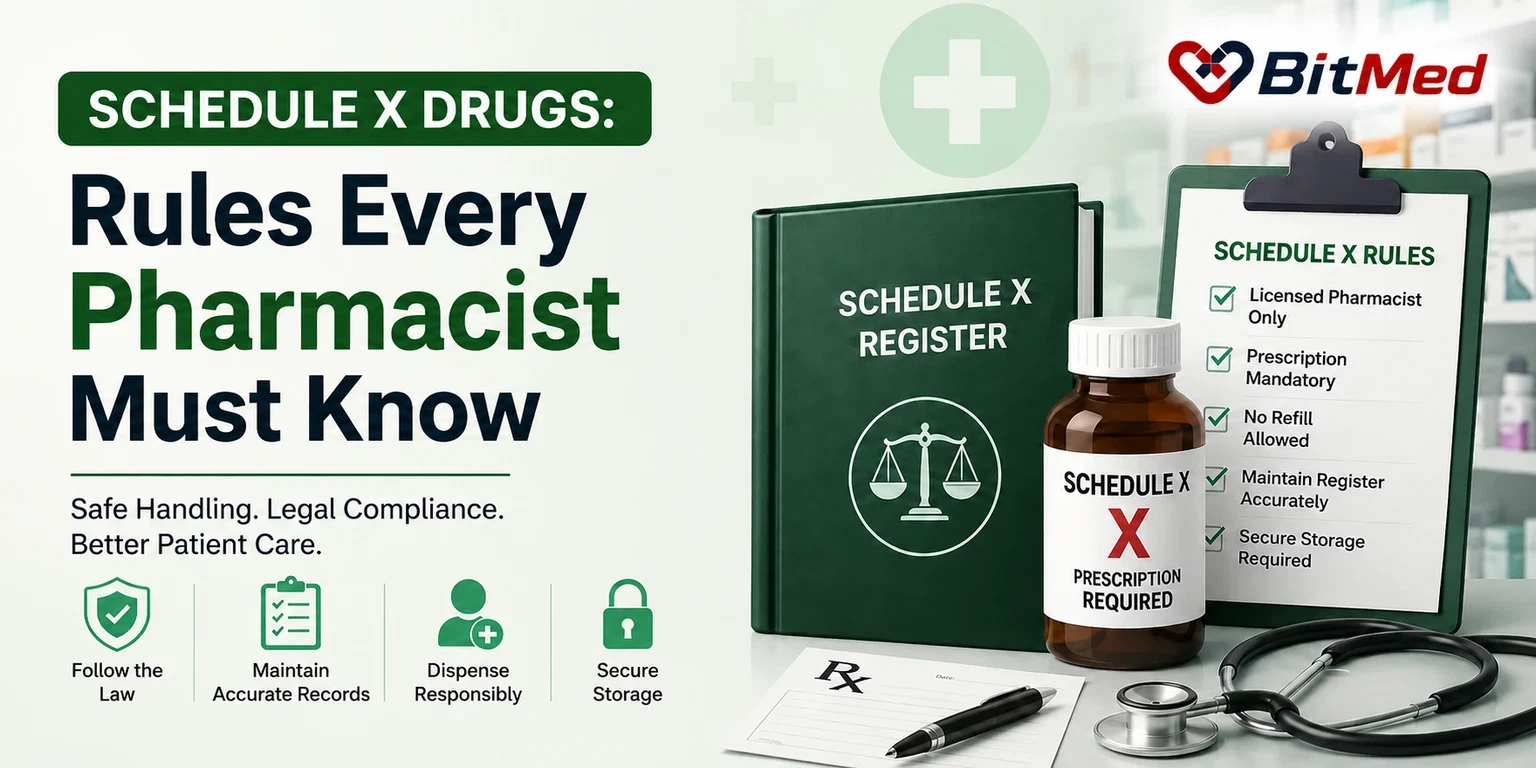
Schedule X is the strictest drug classification under India's Drugs and Cosmetics Rules, 1945. It's reserved for habit-forming medicines with a high potential for abuse — including barbiturates, amphetamine-type stimulants, certain dissociative anaesthetics, and other psychotropic substances. Where Schedule H and H1 drugs already require a prescription and, for H1, a dedicated register, Schedule X adds a further layer of control on top of both: tighter prescription rules, mandatory locked storage, distinct licensing, and specific labelling requirements.
This guide is part of BitMed's broader compliance resource — for the full regulatory picture spanning licensing, GST, and recordkeeping, see Pharmacy Drug Licensing & Compliance in India: The Complete Guide, and for how Schedule X sits alongside the general drug-license categories, see Types of Drug Licenses in India: Retail vs Wholesale vs Composite.
Which Drugs Fall Under Schedule X?
The full Schedule X drugs list is a defined set of 16 substances — together with their salts, stereoisomeric forms, and preparations containing them — all recognized for their high abuse and dependency potential:
| Substance | Class |
|---|---|
| Amobarbital | Barbiturate |
| Barbital | Barbiturate |
| Cyclobarbital | Barbiturate |
| Methylphenobarbital | Barbiturate |
| Pentobarbital | Barbiturate |
| Secobarbital | Barbiturate |
| Amphetamine | Amphetamine-type stimulant |
| Dexamphetamine | Amphetamine-type stimulant |
| Methamphetamine | Amphetamine-type stimulant |
| Methylphenidate | Amphetamine-type stimulant |
| Phenmetrazine | Amphetamine-type stimulant |
| Ketamine | Dissociative anaesthetic |
| Phencyclidine | Dissociative anaesthetic |
| Ethchlorvynol | Sedative-hypnotic |
| Glutethimide | Sedative-hypnotic |
| Meprobamate | Anxiolytic / sedative |
This list is maintained as an appendix to the Drugs and Cosmetics Rules, 1945, and is updated by notification over time — ketamine, for instance, was brought into Schedule X by GSR 724(E) dated 7 November 2013. Because substances can be added over time, pharmacists should treat the current official schedule — not a static list from any single source — as the authoritative reference for which specific drugs require Schedule X handling at any given time.
Schedule X vs Schedule H and H1: Why It's Treated Differently
It helps to see where Schedule X sits relative to the other prescription categories. The Schedule X vs Schedule H1 comparison matters most in practice, since H1 is the category pharmacies most often mistake it for:
| Aspect | Schedule H | Schedule H1 | Schedule X |
|---|---|---|---|
| Prescription required | Yes | Yes | Yes, from a Registered Medical Practitioner |
| Dedicated register | Yes — the prescription register under Rule 65(3)(1) | Yes | Yes — bound, serially numbered register |
| Repeat dispensing on same prescription | Not allowed unless the prescriber authorizes a repeat | Not allowed unless the prescriber authorizes a repeat | Not allowed unless the prescriber authorizes a repeat (Rule 65(11)) |
| Prescription retention | Not specifically mandated | Not specifically mandated | Presented in duplicate; one copy retained two years (Rule 65(9)) |
| Register retention | Two years from the last entry (Rule 65(7)) | Register kept three years (clause (h) of Rule 65(3)(1)) | Register kept two years from the last entry (Rule 65(7)) |
| Storage requirement | Standard | Standard | Locked storage, separate from general stock |
| Distinct license required | No | No | Yes — separate from a standard Form 20/21 retail license |
| Overlap with other legislation | Some substances also fall under the NDPS Act, 1985 | Some substances also fall under the NDPS Act, 1985 | Nearly all substances also fall under the NDPS Act, 1985 |
Schedule H1's enforcement, while important, has been noted as inconsistently applied compared to the tighter, more rigorously enforced controls around Schedule X — which is precisely why pharmacists need to treat Schedule X as a distinct compliance category, not just "a stricter version of H1."
Licensing Requirements for Schedule X Drugs
Selling, stocking, or distributing Schedule X drugs requires a license distinct from a standard retail or wholesale drug license. Rather than the general Form 19 application used for most retail and wholesale licenses, the Schedule X license is applied for in Form 19-C under Rule 59(2) of the Drugs and Cosmetics Rules, 1945, and issued under Rule 61(3) — as a Form 20-F license for retail sale (Form 20-G for wholesale), specific to Schedule X drugs.
In practice, this means a pharmacy wanting to stock and sell Schedule X medicines cannot simply add them under an existing Form 20 or Form 21 retail license — a distinct license application and approval, specific to Schedule X, is required before these drugs can be legally stocked and dispensed. The forms themselves — Form 19-C and Form 20-F — are prescribed centrally in the Rules and don't vary by state; the licensing authority, the fees applied in practice, and procedural details can, so confirm the current process with your State Drug Licensing Authority before applying.
Prescription Rules for Schedule X Drugs
Schedule X drugs can only be sold against a prescription from a Registered Medical Practitioner (RMP) — no exceptions for over-the-counter sale, even for small quantities. Two prescription controls apply: one is shared with Schedule H and H1, and one is specific to Schedule X.
- No repeat without authorization (shared with H and H1): Under Rule 65(11), a prescription for a Schedule H, H1, or X drug must not be dispensed a second time unless the prescriber has stated on it that it may be repeated. This control isn't unique to Schedule X — it applies across all three prescription schedules — but it's one pharmacies still get wrong.
- Duplicate prescription and two-year retention (Schedule X-specific): Under Rule 65(9), Schedule X prescriptions must be presented in duplicate, and the pharmacy must retain one copy for two years — a requirement that applies to Schedule X alone, not to Schedule H or H1. Under Rule 65(9)(b), supplies to Registered Medical Practitioners, hospitals, dispensaries, and nursing homes are instead made against a signed written order, likewise preserved for two years.
Storage Requirements
Under Rule 65(12), Schedule X drugs must be kept in a cupboard or drawer reserved solely for them — stored under lock and key, physically separated from general pharmacy stock. This isn't a suggestion for good practice; it's a specific compliance requirement tied to the abuse-potential classification of these substances, and it's one of the first things a drug inspector checks during a Schedule X compliance review.
Labelling Requirements
Under Rule 97 of the Drugs and Cosmetics Rules, as amended in 2018, Schedule X packaging carries a specific, legally mandated label: the symbol "XRx" displayed in red conspicuously in the top-left corner of the label, accompanied by a separate caution warning written inside a red rectangular box identifying it as a Schedule X drug and warning that it can only be sold at retail on the prescription of a Registered Medical Practitioner. Getting XRx labelling right is a routine inspection checkpoint.
"XRx", not "NRx"
Older reference material sometimes calls this an "NRx" label — wording that predates the 2018 amendment to Rule 97, which is exactly what established "XRx" as the Schedule X symbol, so that older usage is genuinely outdated. Today "NRx" (in red) is the mandated symbol for Schedule H drugs that also fall under the NDPS Act — not Schedule H1, which uses "Rx" in red. Always check current Schedule X compliance against the "XRx" labelling standard.
The Schedule X Register: What Must Be Recorded
Under Rule 65(21), every Schedule X sale must be recorded in a dedicated register that is bound and serially numbered, with separate pages maintained for each drug — not a loose-leaf or digital-only record without an auditable structure. The register must record the following particulars for each transaction:
- The date of the transaction.
- The quantity received, where applicable, with the supplier's name, address, and drug-license number.
- The name of the drug.
- The quantity supplied.
- The manufacturer's name.
- The batch or lot number.
- The name and address of the patient or purchaser.
- The reference number of the prescription against which the supply was made.
- The bill number and date for the purchase or supply.
- The signature of the person under whose supervision the drugs were supplied.
The register must be available for inspection at any time and, under Rule 65(7), preserved for at least two years from the date of the last entry. Much like the Schedule H1 register, its accuracy depends entirely on the discipline of whoever is billing at the counter unless the system enforces the entry automatically.
Overlap With the NDPS Act, 1985
Nearly all of the 16 Schedule X substances — the barbiturates, the amphetamine-type stimulants, phencyclidine, glutethimide, ethchlorvynol, meprobamate, and ketamine — are also listed as psychotropic substances under the Narcotic Drugs and Psychotropic Substances (NDPS) Act, 1985, a separate law with its own, considerably harsher criminal penalty structure. So a compliance failure involving Schedule X drugs usually isn't only a Drugs and Cosmetics Rules issue — it can trigger NDPS Act consequences as well. The safer working assumption is that NDPS oversight applies across the Schedule X category, treating any exception as the thing to confirm — not assuming NDPS is the exception and that Schedule X compliance sits under one law.
Common Compliance Mistakes With Schedule X Drugs
- Treating Schedule X like Schedule H1 — assuming the H1 register satisfies Schedule X recordkeeping, when Schedule X requires its own distinct register, separate licensing, and duplicate-prescription retention.
- Dispensing a repeat sale on the same prescription without confirming the prescriber specifically authorized it.
- Storing Schedule X stock alongside general inventory rather than under separate lock and key.
- Using "NRx" labelling assumptions instead of the current "XRx" standard — "NRx" is the symbol for Schedule H drugs that fall under the NDPS Act, not a Schedule X label.
- Not retaining a duplicate copy of the prescription for the full two-year period.
- Substituting another preparation for the one prescribed — under Rule 65(11-A), a person dispensing a Schedule H, H1, or X prescription may not supply any other preparation in its place, whether or not it contains the same substances.
- Assuming a standard retail license (Form 20/21) covers Schedule X sale, when a distinct license is required.
Given the NDPS Act overlap across most of the category, compliance failures here carry more serious consequences than most other retail pharmacy violations — this is an area where "we'll tighten it up later" is a genuinely risky approach, not just a minor administrative gap.
How BitMed Supports Schedule X and Controlled-Substance Compliance
BitMed's product master recognizes drug schedule classifications — including H, H1, and X — as part of each medicine's record, which helps a pharmacy identify controlled and restricted items correctly at the point of billing rather than relying on staff memory to flag them. Combined with BitMed's batch-wise inventory tracking and secure, cloud-backed recordkeeping, this supports the broader discipline Schedule X compliance depends on — accurate, retrievable records that stand up to inspection.
It's worth being clear about scope: BitMed's confirmed, automatic point-of-billing enforcement is built specifically around the Schedule H1 register. For Schedule X's distinct licensing, storage, and register requirements, pharmacies should continue following the dedicated Schedule X process — a separate license, locked physical storage, the bound serial register, and two-year prescription retention — as outlined above, treating software as support for accurate recordkeeping rather than a replacement for these specific regulatory steps.
Frequently Asked Questions
What makes Schedule X different from Schedule H1?
Schedule X requires a distinct license separate from a standard retail license, mandates locked storage separate from general stock, and requires a dedicated bound and serially numbered register plus a duplicate prescription retained for two years — all of which go beyond Schedule H1. The no-repeat-without-authorization rule, by contrast, applies to Schedule H, H1, and X alike, so it isn't what sets Schedule X apart.
Can a pharmacy sell Schedule X drugs under its regular Form 20 or Form 21 license?
No. Selling Schedule X drugs requires a separate, dedicated license specific to that schedule — a Form 20-F retail license, applied for in Form 19-C under Rule 59(2) and granted under Rule 61(3) — in addition to a standard retail license, depending on the pharmacy's setup.
How long must a pharmacy retain a Schedule X prescription?
Two years. The prescription must be presented in duplicate, and the pharmacy must retain one copy for this period. This is a specific requirement distinct from general prescription recordkeeping practices for other schedules.
Can a Schedule X prescription be refilled like a regular prescription?
Not by default. Under Rule 65(11), a prescription for a Schedule H, H1, or X drug cannot be dispensed again unless the prescriber has stated on it that it may be repeated — so this control applies to Schedule X but isn't unique to it.
What labelling is required on Schedule X drug packaging?
Since the 2018 amendment to Rule 97, the rules require the "XRx" symbol in red in the top-left corner of the label, along with a separate caution warning inside a red rectangular box identifying it as a Schedule X drug requiring a Registered Medical Practitioner's prescription. Older "NRx" references for these drugs are outdated: "NRx" (in red) is the mandated symbol for Schedule H drugs that also fall under the NDPS Act, while Schedule H1 uses "Rx" in red.
Are Schedule X drugs also covered under the NDPS Act?
Nearly all of them are. Most of the 16 Schedule X substances — the barbiturates, the amphetamine-type stimulants, phencyclidine, glutethimide, ethchlorvynol, meprobamate, and ketamine — are also listed as psychotropic substances under the NDPS Act, 1985, which carries its own, more severe penalty structure separate from the Drugs and Cosmetics Rules. The safer assumption is that NDPS oversight applies across the Schedule X category rather than to a few exceptions.
What happens if a pharmacy fails to maintain proper Schedule X records?
Consequences can include suspension or cancellation of the drug license, and prosecution under the Drugs and Cosmetics Act, 1940 itself, which provides for fines and imprisonment for contraventions. For substances also covered under the NDPS Act, 1985, the potential consequences are more severe still. Given this, Schedule X recordkeeping should be treated as a strict, non-negotiable compliance obligation.
Conclusion
Schedule X represents the highest level of retail control in India's pharmacy regulations, and treating it with the same processes used for Schedule H or H1 is one of the most consequential mistakes a pharmacy can make. Distinct licensing, locked storage, a dedicated serially numbered register, duplicate prescriptions retained for two years, current "XRx" labelling, and awareness of NDPS Act overlap all need to be treated as their own compliance track — not an extension of general prescription-drug handling.
For the complete compliance picture beyond Schedule X — licensing categories, GST, and general recordkeeping — see Pharmacy Drug Licensing & Compliance in India: The Complete Guide. And for the operational side of accurate, inspection-ready recordkeeping across all drug schedules, BitMed's Pharmacy Management Software is built to support Indian pharmacies with schedule-aware product data and secure, cloud-based records.
Controlled-substance records that stand up to inspection
See how BitMed supports schedule-aware inventory and secure recordkeeping for Indian pharmacies at bitmed.in.
Explore BitMed